


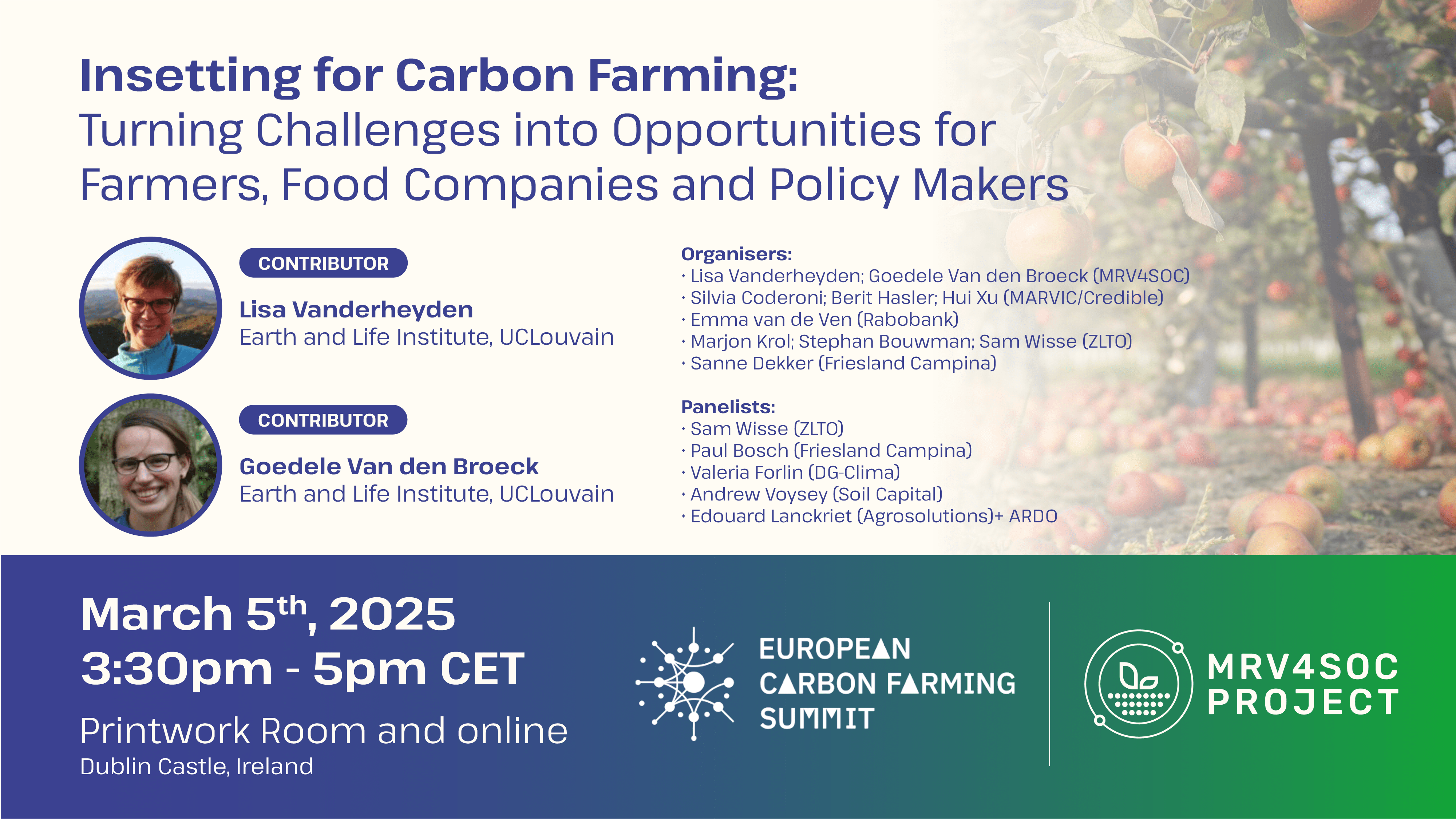
At the European Carbon Farming Summit (ECFS) 2025, MRV4SOC partner UCLouvain co-organized a high-impact session titled “Insetting for Carbon Farming: Turning Challenges into Opportunities for Farmers, Food Companies, and Policy Makers”. The session brought together key stakeholders from across the agricultural and financial sectors to discuss insetting’s potential and the role of the EU’s Carbon Removal Certification Framework (CRCF) in shaping its future.
Key Takeaways from Panel Discussion
Moderated by Emma van de Ven (Rabobank), the panel featured Sam Wisse (ZLTO), Paul Bosch (FrieslandCampina), Valeria Forlin (DG-Clima), Andrew Voysey (Soil Capital), and Edouard Lanckriet (Agrosolutions + Ardo). The discussion explored the major challenges insetting faces today and how the CRCF could provide effective solutions.
Insetting vs. Offsetting: A New Paradigm
- Insetting fosters value creation at the farm level and distributes benefits across the supply chain.
- Offsetting, by contrast, sells carbon credits externally, often without direct benefits to farmers.
Challenges in Implementing Insetting
- Lack of Standardisation & Regulation – Diverse funding mechanisms and conflicting standards create uncertainty.
- Ensuring Value Creation – Transparent allocation rules are necessary to fairly distribute benefits and risks.
- Administrative & Financial Burden – Farmers, intermediaries, and agrifood companies face high costs and complex MRV (Monitoring, Reporting, and Verification) requirements, limiting accessibility and impact.
How the CRCF Can Support Insetting
- Establishing a unified framework for carbon farming, integrating offsetting, insetting, and CAP schemes.
- Creating a single registry to prevent double counting and improve claim tracking.
- Enhancing sustainability reporting with standardised and transparent methodologies.
- Leveraging public-private funding mechanisms to scale up insetting initiatives.
Next Steps for CRCF Development
- Developing a universal benchmarking system for farm sustainability reporting.
- Clarifying insetting’s place in the CRCF with clear rules on allocation and inventory accounting.
- Adopting a holistic sustainability approach, incorporating soil health, water conservation, and biodiversity.
- Defining the market demand for CRCF and its role in emissions reduction efforts.
As the EU refines its carbon farming policies, further development of the CRCF will be critical in driving sustainable transformation for farmers and agrifood companies alike.
For those who missed the session, a recording is available here (starting at 7:04:00).